
 WBW.LIFE · Wellbeing Beyond Wellness · wbw.life/blog/resonance-breathing
Resonance breathing
Resonance Breathing: How to Find Your Personal Breathing Rate
There is a slow breathing pace at which your heart rhythm swings most strongly. It is different for everyone, and it takes 17 minutes to find yours.
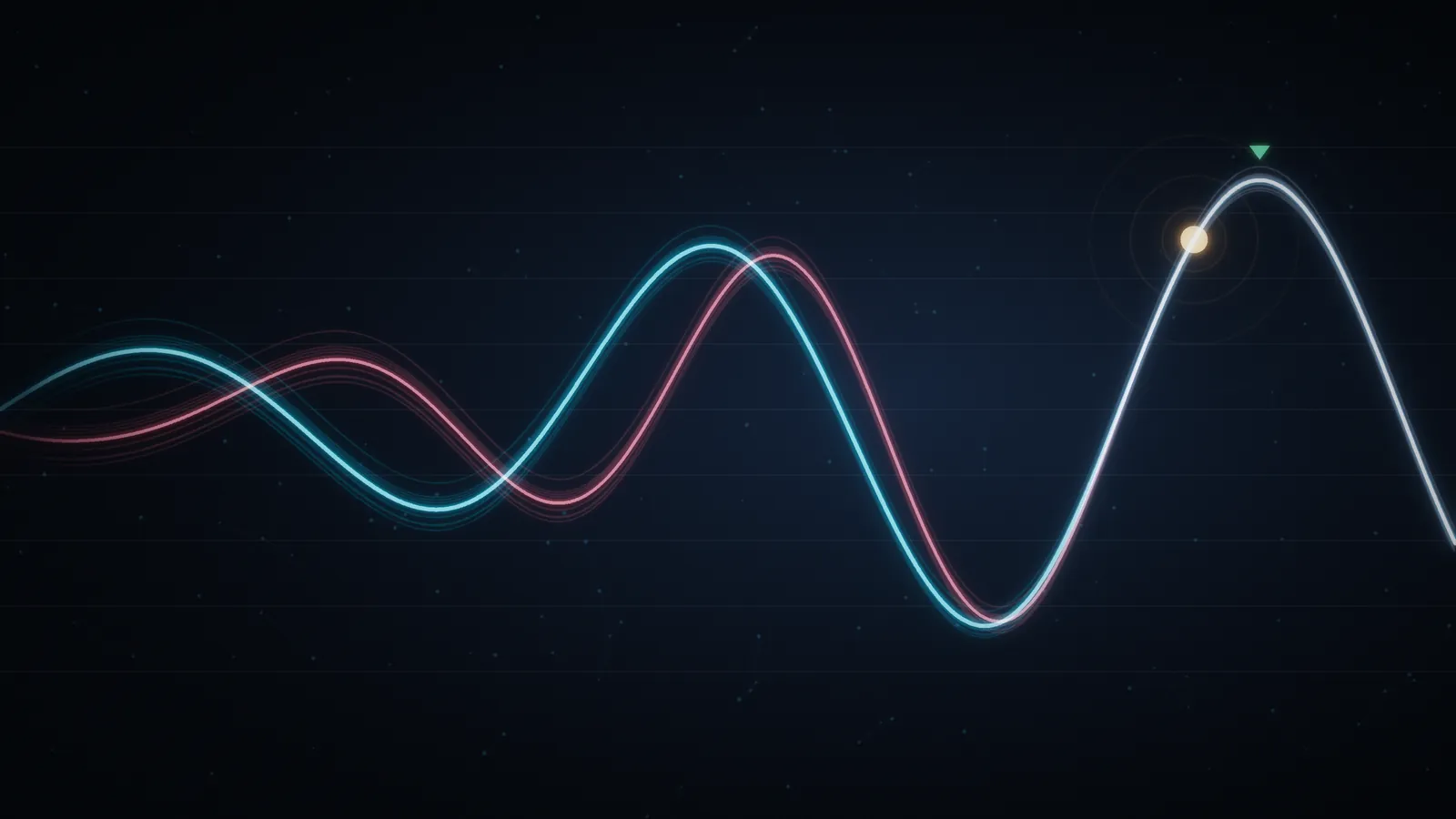
Most breathing advice gives everyone the same count. Box breathing, four-seven-eight, six breaths a minute. Resonance breathing starts from a different idea: there is one slow pace at which your own heart and blood pressure reflexes move together most strongly, and it is worth finding.
Key points
- Resonance breathing is slow, gentle breathing at the pace where your heart rate rises and falls most with each breath.
- For most adults that pace sits somewhere between about 4.5 and 7 breaths a minute, and it varies from person to person.
- Research led by Paul Lehrer and Evgeny Vaschillo shows it produces large, regular swings in heart rate and can strengthen the baroreflex.
- A 2020 meta-analysis of 58 trials found small to moderate benefits across many outcomes, with the largest for anxiety, stress and depression.
What resonance breathing is
Resonance breathing, also called resonance frequency breathing or heart rate variability (HRV) biofeedback, means breathing slowly and smoothly at a specific rate: your resonance frequency. At that rate, the natural rise and fall of your heart rate with each breath becomes as large and as regular as it can be.
It is not about breathing deeply. Big breaths can leave you light-headed. The aim is slow, soft and comfortable, usually in through the nose.
What happens in your body
Your heart speeds up as you breathe in
Breathe in and your heart rate rises a little. Breathe out and it falls. This normal rhythm is called respiratory sinus arrhythmia.
Your blood pressure reflex has its own rhythm
Stretch sensors in the carotid arteries and the aortic arch report blood pressure to the brainstem, which adjusts heart rate to keep pressure steady. This loop is the baroreflex. Because signals take time to travel around it, the loop creates its own slow rhythm, roughly one cycle every 10 seconds.
Match the two and they amplify each other
Breathe at about the same pace as that reflex rhythm and the two reinforce each other. Heart rate swings become much larger, a little like pushing a swing at exactly the right moment. This is cardiovascular resonance.

What the research shows
The mechanism
In 2006, Vaschillo, Vaschillo and Lehrer showed in Applied Psychophysiology and Biofeedback that breathing at each person's resonant frequency produced large oscillations in heart rate, blood pressure and vascular tone. The resonant frequency differed between people and stayed stable across sessions.
A stronger baroreflex
In 2003 Lehrer and colleagues reported that a course of HRV biofeedback increased baroreflex gain, a measure of how strongly the reflex responds. In their 2014 review, Lehrer and Gevirtz concluded that strengthening baroreflex-related regulation is the best-supported explanation for how the practice works, with vagal signals to emotion-related brain areas, and reduced inflammation, proposed as further pathways.
Stress, anxiety and mood
A 2017 meta-analysis by Goessl, Curtiss and Hofmann pooled 24 studies and 484 participants and found a large reduction in self-reported stress and anxiety. A 2020 meta-analysis by Lehrer and colleagues covered 58 randomised trials and found small to moderate benefits across many outcomes, with the largest effects for anxiety, depression, anger, and athletic and artistic performance.
The brain
In a 2023 randomised trial of 106 young adults, Nashiro and colleagues found that five weeks of daily practice to raise heart rate oscillations increased connectivity between the left amygdala and the medial prefrontal cortex, regions involved in regulating emotion.
Why your number matters
Six breaths a minute is a good starting point for most adults. But the resonance frequency is linked to body size and sex, and it differs from person to person. Breathing a little too fast or too slow for you gives smaller heart rate swings. Measuring it takes the guesswork out, and gives you a number you can practise with for months.
How we measure it at WBW
Our Resonance Breathing assessment takes 17 minutes, seated, in a private suite in the Perth CBD.
- Connect. A Polar H10 chest sensor streams your beat-to-beat heart data to our purpose-built Resonant app, which calculates your HRV live.
- Ramp down. The pacer starts at 12 breaths a minute and steps down gradually. Rise with the orange dot to breathe in, fall with it to breathe out. Gentle haptic cues mean you can close your eyes.
- Measure. At each pace the app tracks how far your heart rate rises and falls with every breath.
- Find your number. The pace that produces the largest, smoothest swing is your Resonant Frequency Breath Rate Number, for example 5.75 breaths a minute.
You leave with your number and a simple routine. It is a core pillar of The T×P Method, and it pairs well with a Vielight Brain Session on recovery days. For the full science, including illustrated guides to the baroreflex and the vagus nerve, see our Resonance Breathing page.
How to practise
- Little and often. Many research programmes use around 20 minutes a day, often split into two sessions.
- Slow, not deep. Breathe softly through the nose. If you feel light-headed or tingly, breathe normally for a minute.
- Longer out-breath. A slightly longer exhale feels calming for most people.
- Use a pacer. A simple visual or haptic pacer set to your number keeps you on rhythm.
- Recheck. Your number can shift as fitness and HRV change, so reassess from time to time.
Resonance breathing is gentle and suits most people. If you have a heart rhythm condition, a respiratory condition, low blood pressure or a pacemaker, tell us before your session. If you are pregnant or have a medical condition, check with your doctor first.
Questions people ask
01What is a normal resonance breathing rate?
For most adults it falls somewhere between about 4.5 and 7 breaths a minute. Six breaths a minute is a common starting point, but your own rate can sit above or below it.
02How is resonance breathing different from box breathing?
Box breathing uses a fixed count for everyone. Resonance breathing uses the specific pace at which your own heart rate swings most, measured with a heart sensor.
03Do I need equipment at home?
No. Once you know your number, a simple pacer app or a timer is enough. The heart sensor is only needed for the assessment.
04How long until I notice a difference?
Many people feel calmer during the first session. Research programmes that measured changes in the baroreflex and brain connectivity ran for several weeks of daily practice.
05Will my number change?
It tends to be stable, but it can shift as fitness and HRV change. We reassess members periodically.
Sources
- Vaschillo EG, Vaschillo B, Lehrer PM. Characteristics of resonance in heart rate variability stimulated by biofeedback. Applied Psychophysiology and Biofeedback, 2006. Link
- Lehrer PM, et al. Heart rate variability biofeedback increases baroreflex gain and peak expiratory flow. Psychosomatic Medicine, 2003.
- Lehrer PM, Gevirtz R. Heart rate variability biofeedback: how and why does it work? Frontiers in Psychology, 2014. Link
- Goessl VC, Curtiss JE, Hofmann SG. The effect of heart rate variability biofeedback training on stress and anxiety: a meta-analysis. Psychological Medicine, 2017. Link
- Lehrer P, et al. Heart rate variability biofeedback improves emotional and physical health and performance: a systematic review and meta analysis. Applied Psychophysiology and Biofeedback, 2020. Link
- Nashiro K, et al. Increasing coordination and responsivity of emotion-related brain regions with a heart rate variability biofeedback randomized trial. Cognitive, Affective and Behavioral Neuroscience, 2023. Link
- Shaffer F, Meehan ZM. A practical guide to resonance frequency assessment for heart rate variability biofeedback. Frontiers in Neuroscience, 2020. Link
- Vukojević B, Vater C, Laborde S. The role of resonance frequency in slow-paced breathing: systematic review. Current Issues in Sport Science, 2024. Link
This article is general information, not medical advice. WBW sessions are for general wellness and are not intended to diagnose, treat, cure or prevent any disease.
Book at WBW, Perth CBD
Find your number.
Resonance Breathing assessment, 17 minutes. Polar H10 and our purpose-built Resonant app. Perth CBD.
Keep reading

Brain health
Brain Health: Why It Matters and How Photobiomodulation Fits In
Your brain is about 2 percent of your body weight and uses around a fifth of its energy. Here is how to look after it, and where near-infrared light fits in.